The Better
Sleep Guide
10 Science-Backed Tips to
Beat Back & Neck Pain
and Sleep Deeper
Your complete guide to pain-free, restorative sleep — including the sleep products osteopaths trust.
Welcome to Your
Better Sleep Journey
If you're waking up stiff, exhausted, or in pain — you're not alone. Research shows that over 65% of people with chronic back and neck pain are suffering because of poor sleep posture caused by the wrong mattress surface or pillow. The good news? It's fixable.
This guide walks you through 10 proven, expert-backed strategies to reduce pain, improve your sleep quality, and wake up feeling genuinely restored. We'll also show you exactly how the right sleep equipment — designed with leading osteopaths — can make the biggest difference from night one.
What's Inside
Why You Wake Up
In Pain Every Morning
When your sleep surface doesn't support your body's natural curves, several painful things happen overnight — most of them completely invisible until you feel them the next morning.
- Spinal misalignment Your vertebrae are pushed out of their natural position, creating sustained tension in surrounding muscles and discs across 7+ hours.
- Muscle fatigue Muscles work overtime trying to compensate for poor support, leading to the stiffness and soreness you feel the moment you get out of bed.
- Nerve compression Prolonged pressure on specific areas compresses nerves, causing the tingling, numbness or deep ache many people feel on waking.
- Poor circulation A surface that's too firm creates pressure points that restrict blood flow to muscles and joints throughout the night.
- Disrupted sleep cycles Discomfort causes micro-awakenings throughout the night, preventing you from reaching or maintaining deep, restorative sleep stages.
Posture Doesn't
Stop When You Sleep
Most people think of posture as something they consciously control — sitting up straight at a desk, not hunching over a screen. But your sleeping posture is just as critical, and it's completely passive. You have no conscious control over it once you're asleep.
Neutral Spine = Pain-Free Mornings
- Your spine has a natural S-curve that must be maintained during sleep
- The wrong surface flattens or exaggerates this curve over 7+ hours
- Neck, lower back, and hip pain are the direct result
- Most people have never slept on a surface calibrated to their body
Sleep Positions & Spine Impact
- Side sleeper — Most common. Risk: shoulder & hip pain if surface too firm.
- Back sleeper — Best for spine. Risk: lower back sags on soft surface.
- Front sleeper — Highest strain on cervical spine and lower back.
Brightr pillows are adjustable, and you can customise how thick or thin you want your pillow. That's what makes them perfect for comfort and support.
10 Tips: Better Sleep & Less Pain
Fix Your Sleep Position First
Side sleepers: keep your hips stacked and place a pillow between your knees. Back sleepers: put a pillow under your knees. These micro-adjustments reduce spinal load by up to 40% and can eliminate lower back pain almost immediately.
Upgrade Your Pillow Height — Tonight
Most people use the wrong pillow height for their build and sleep position. Side sleepers need more height (to fill the gap between shoulder and head). Back sleepers need less. A pillow that's even 2cm too low or high creates the neck misalignment that causes morning stiffness. Test: your nose should be level with your sternum in the side position.
→ Browse Brightr® adjustable pillows — find your perfect heightReplace the Surface, Not the Mattress
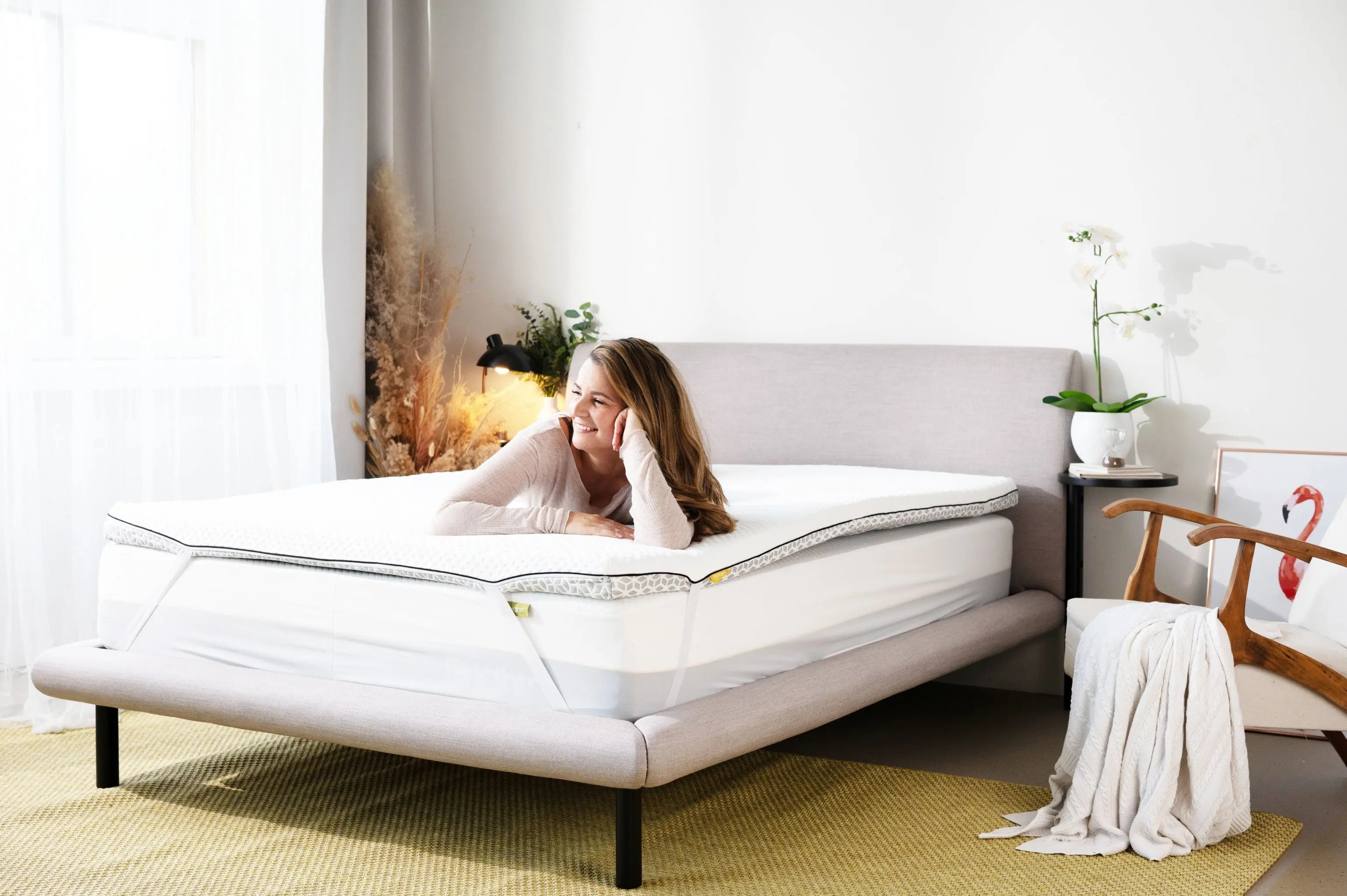
80% of sleep discomfort is caused by the top 3–5cm of your mattress — the comfort layer — not the support core. Before spending £500–£2,000 on a new mattress, add a quality memory foam topper. Most customers report the same results at a fraction of the cost.
→ See the Brightr® topper range — from £99. 100-night trial.Create a Consistent Sleep Routine
Your body's circadian rhythm regulates pain sensitivity, hormone production, and cellular repair. Going to bed and waking at the same time daily (even weekends) reduces inflammation and improves deep sleep by up to 25%. Aim for 7–9 hours in a consistently dark, cool (16–18°C) room.
Cool Down Your Sleep Environment
Body temperature naturally drops at sleep onset. A room that's too warm prevents this drop, reducing deep sleep and increasing pain sensitivity. Keep your bedroom at 16–18°C and consider a cooling mattress topper — Brightr's SolaceChill™ technology dissipates heat rather than trapping it.
→ Aurora Topper — copper-infused cooling cover, 2-in-1 firmnessStretch for 5 Minutes Before Bed
Three simple stretches reduce overnight muscle tension dramatically: (1) Cat-Cow — 10 slow cycles to mobilise the spine. (2) Knee-to-Chest hold — 30 seconds each side to release hip flexors. (3) Neck lateral stretch — 20 seconds each side to decompress the cervical spine.
Reduce Screen Light After 9pm
Blue light suppresses melatonin production by up to 50%, delaying sleep onset and reducing deep, restorative sleep. Use night mode, blue-light glasses, or — best of all — put screens away 60–90 minutes before bed. Swap scrolling for 10 minutes of light reading or breathing exercises.
Check Your Pillow's Age
Memory foam pillows lose up to 30% of their support properties within 2–3 years. A flat or unsupportive pillow is the single most common cause of neck pain and morning headaches. If your pillow is older than 2 years, the investment in a new adjustable pillow will likely pay for itself in pain relief within the first week.
→ Brightr® adjustable pillows — 30-night trial · copper-infused coverManage Stress — It Lives in Your Muscles
Cortisol (the stress hormone) causes muscle tension that doesn't switch off at night. Even 5 minutes of slow breathing (4 counts in, 6 counts out) before sleep activates the parasympathetic nervous system and reduces overnight muscle tension measurably.
Get Your Sleep Assessed — Free
Most people have never considered whether their sleep set-up is right for their body type and pain profile. Brightr's free online Pillow Quiz uses an osteopath-recommended algorithm to match you to the perfect support combination. Takes 2 minutes. Over 70,000 customers have used it — 95% found their perfect pillow first time.
→ Take the free Pillow Quiz — personalised recommendation in 60 secondsYour Perfect Sleep
Position Guide
The right pillow height for your sleep position reduces neck strain by up to 60%. Here's exactly what each position needs.
Best for: spine alignment, snoring, acid reflux
Keep hips stacked, knees slightly bent. Place a pillow between your knees. Use a higher, firmer pillow to fill the shoulder gap. Medium-firm mattress/topper for hip pressure relief.
Best Brightr: Eclipse or Luna →Best for: spine neutrality, face skin, breathing
Place a pillow under your knees to reduce lumbar strain. Use a lower-profile pillow (less height needed). Avoid pillows that push chin to chest. Medium-firm mattress or topper is ideal.
Best Brightr: Stella or Nox →Highest strain position — transitioning recommended
Use the thinnest pillow possible (or none). Place a pillow under your pelvis to reduce lumbar arch. A firmer topper helps maintain hip level. Start transitioning by using a pillow between knees on your side.
Best Brightr: Nox (go minimal) →Why Your Pillow Is the
Most Important Thing In Your Bedroom
Your pillow is the only piece of sleep equipment in direct contact with your head and neck for the entire night. Yet most people haven't critically assessed their pillow in years — or ever.
Why Most Pillows Fail You
- Wrong height from day one Standard pillows are made to a one-size-fits-all height that suits almost nobody's shoulder width or sleep position.
- No adjustment possible Once compressed, a standard pillow stays compressed. You can't add or remove filling to recalibrate it to your body.
- Heat trapping Standard foam traps body heat. A warm sleeping surface disrupts deep sleep, increases cortisol, and amplifies pain sensitivity overnight.
- Allergen accumulation A 2-year-old pillow can contain millions of dust mites and their waste — directly below your face for 8 hours a night.
- Gradual degradation Memory foam loses up to 30% of support within 2–3 years. Most people notice the symptom (neck pain) but never identify the cause (pillow age).
Four Pillows. Every Sleep Type.
Osteopath-Approved.
Luxuriously soft, breathable fibres made from recycled materials. Cloud-like feel without allergens. Adjustable fill lets you dial in the exact loft you need.
The perfect balance of cloud-soft comfort and memory foam support. Three adjustable layers let you customise firmness and height independently.
Three mouldable shredded graphene foam layers deliver body-hugging support that adapts to your position throughout the night. Add or remove filling for your exact height.
Firm, structured memory foam with a copper-infused cooling cover. Best-rated by chiropractors. Holds its shape all night for consistent cervical spine support.
Why Your Mattress Surface
Is Failing You
Here's something most people don't realise: when a mattress starts causing pain, it's almost never the support core. It's the comfort layer on top that has lost its pressure-relief properties — while the rest of the mattress feels perfectly fine.
The 3 Ways Your Mattress Surface Causes Pain
- Pressure Point Build-Up Hips, shoulders and lower back bear disproportionate load, restricting blood flow and causing the aching, tingling discomfort many people experience during the night.
- Spinal Sag A worn or too-soft comfort layer lets your spine sink below its natural curve. Overnight, this places sustained strain on your lumbar and thoracic vertebrae. The right topper corrects this immediately.
- Heat Trapping Most mattress comfort layers use standard foam or thick padding that insulates body heat. Sleeping hot increases cortisol, reduces deep sleep, and amplifies pain sensitivity. Brightr toppers actively dissipate this heat.
New mattress
- £500–£2,000 upfront
- 10-minute showroom trial
- 2–6 week delivery
- Old mattress to dispose of
- Often wrong after purchase
Brightr Topper
- Fraction of the cost
- 100-night home trial
- 2–3 day delivery
- Sits on your existing mattress
- Free return if not satisfied
Every Body Type. Every Sleep Need.
Osteopath-Designed.
Soft side for pressure relief; medium-firm side for spinal alignment. The best-selling topper in the Brightr range. Ideal for side sleepers and hip or shoulder pain.
Shop Aurora →Premium upgrade of the Aurora with an enhanced copper-infused cover and deeper foam layer. For those who want hotel-grade comfort with clinical-grade support.
Shop Aurora Deluxe →Dual firm foam layers for those who need structure. Fixes sagging mattresses. Improves posture for front and back sleepers with lower back pain.
Shop Titan →Maximum support. Extra firm side delivers ultra-deep structural support. Perfect for those with chronic lower back conditions or a heavily compressed mattress.
Shop Titan Deluxe →What
Osteopaths Say
Brightr® mattress toppers are adjustable, and you can customise them for your sleep position. That's what makes them perfect for better spine alignment, reduction of pressure points, and better sleep posture.
"Back pain practically vanished after just one week. I wish I'd found this sooner."
"I no longer wake up with neck pain. It's the perfect firmness for me."
"My back pain eased a lot — I'm not as stiff waking up. Amazing product."
Ready to Sleep
Pain-Free?
You've read the science. You know what's causing the pain. Now it's time to fix it — with the tools osteopaths actually recommend to their patients.
🛏️ Mattress Toppers
Add ergonomic support and pressure relief to your existing mattress. Two firmness levels in one. 100-night trial.
- ✓ Aurora — soft/medium-firm (side sleepers)
- ✓ Titan — firm/extra-firm (back sleepers, lower back pain)
- ✓ 100-night trial · 5-year warranty
💊 Adjustable Pillows
Find your perfect height and feel. Copper-infused cooling cover. Adjustable fill. 30-night trial.
Take the Free Quiz →Your Exclusive Offer
Up to 30% off all mattress toppers & pillows
No code needed · 100-night trial · Free UK delivery · brightrsleep.com/quiz
Shop Now — Up to 30% Off